
How Does Dive Concepts Compare to Other Dive Centers on Nusa Lembongan?

Updated: Oct 8
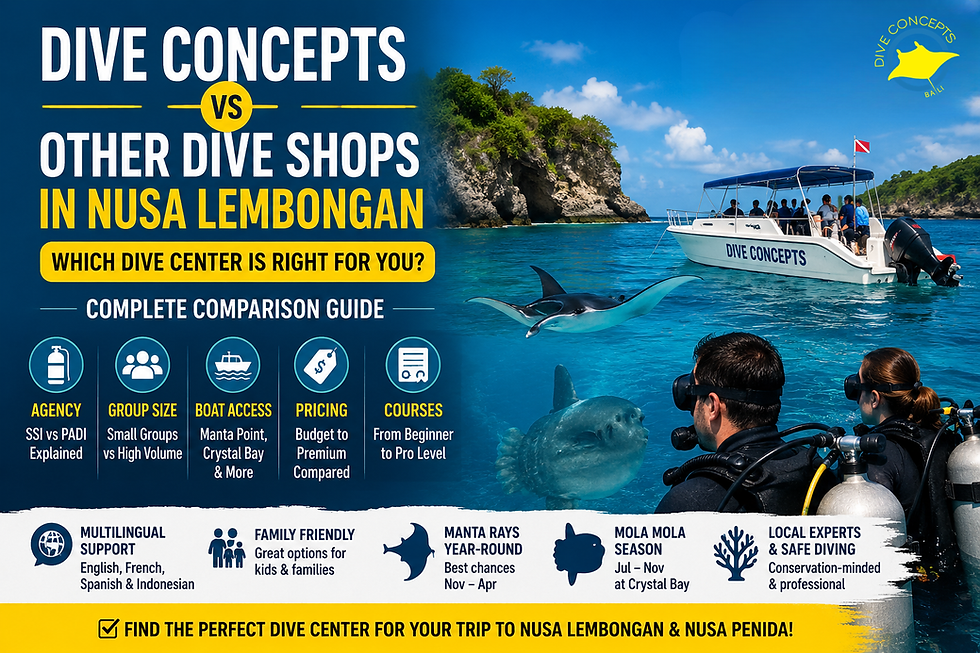
If you're choosing between Dive Concepts and the other dive shops clustered around Jungut Batu village, the short answer is this: Dive Concepts stands out for its SSI-based training, budget-friendly pricing, and multilingual team, while operators like Two Fish Divers and World Diving lean on PADI certification, small-group diving, and on-site dive resorts. None of them is objectively "the best" ; the right choice depends on whether you're certifying for the first time, chasing mola mola season, or traveling with a family.
This guide compares Dive Concepts against its closest Nusa Lembongan competitors using the criteria that actually affect your trip: certification agency, group size, boat access to Manta Point and Crystal Bay, pricing, courses, accommodation, and language support. You'll also get a simple framework for matching your diving goals to the right operator.
Dive Concepts vs the Rest of Nusa Lembongan
Dive Concepts is one of Bali's larger multi-location operators (it also runs centers in Amed, Tulamben, and Pemuteran), based in Jungut Batu on Nusa Lembongan since 2009. It trains divers through SSI rather than PADI, runs a fleet of boats to Manta Point and Crystal Bay, and is generally positioned as one of the more affordable full-service options on the island. Its closest comparable competitors Two Fish Divers, World Diving Lembongan, Blue Corner Dive, and Lembongan Dive Center mostly train through PADI, several operate on-site dive resorts, and pricing and group sizes vary shop to shop.
Meet the Main Dive Centers on Nusa Lembongan
Nusa Lembongan and neighboring Nusa Penida sit inside the Nusa Penida Marine Protected Area, a roughly 200 km² zone established in 2010 to balance tourism with reef conservation. Within that small area, a cluster of dive operators compete for the same divers heading to the same handful of famous sites. The main names you'll encounter while researching are:
Dive Concepts SSI dive center in Jungut Batu, part of a four-location Bali operation (Amed, Tulamben, Pemuteran, Lembongan).
Two Fish Divers PADI 5-Star operator with locations in both Jungut Batu (Lembongan) and Batumulapan/Sampalan (Nusa Penida), part of a five-location international group with a cross-location loyalty program.
World Diving Lembongan PADI 5-Star resort in Jungut Batu, operating since 1998, with an on-site training pool, house reef, and accommodation.
Blue Corner Dive a beachfront dive resort with bungalow accommodation and an on-site pool, popular for combining diving with a longer island stay.
Lembongan Dive Center, a small, locally-owned PADI resort on the main beach, positioned around personalized, small-group service.
Each of these has genuinely positive guest feedback online, which is part of why comparing them on marketing language alone doesn't get you very far. The differences that matter are structural: which certification agency, how many divers per guide, what boats they run, and what you're actually paying for.
Certification Agency: SSI vs PADI, and Why It Matters
Direct answer: SSI (Scuba Schools International) and PADI (Professional Association of Diving Instructors) are both internationally recognized, insurance-backed certification agencies, and a certification from either is accepted at dive centers worldwide. Dive Concepts trains through SSI; most of its Nusa Lembongan competitors train through PADI.
For a tourist choosing where to get certified, the practical difference is smaller than it sounds. Both agencies teach the same core skills to comparable safety standards, both certifications are lifetime and globally recognized, and both let you rent gear or book dives anywhere in the world afterward. The differences that do matter:
App-based theory: SSI's digital learning platform is often cited by divers as slightly more mobile-friendly for pre-course study, though PADI's eLearning is equally functional.
Course naming: Some course names differ (e.g., SSI "Open Water Diver" vs PADI "Open Water Diver" largely equivalent, but specialty course names diverge further up the ladder).
Continuing education: If you plan to keep diving regularly with a specific home dive shop elsewhere, matching agencies can make it marginally simpler to log continuing education, though cross-agency recognition works fine for casual diving.
Practical takeaway: Don't choose based on agency alone unless you have a specific reason to (for example, you're mid-way through a PADI Divemaster program and need PADI-specific paperwork). For a first certification or fun diving, agency is a minor factor compared to instructor quality, group size, and site access.
Group Size and Instructor Ratios
Direct answer: Smaller diver-to-guide ratios generally mean more individual attention, more flexibility to hover near marine life, and calmer dives in current-prone sites but they can also mean higher prices and fewer daily departure options.
Two Fish Divers has publicly emphasized small-group fun diving, with historical guest reports referencing groups capped around four divers per guide. Lembongan Dive Center markets itself around a similarly personalized, small-operation approach. Dive Concepts runs a larger fleet (reported at four boats) and higher daily trip volume, which supports more schedule flexibility and typically lower per-dive pricing, though it means larger overall group sizes on Manta Point and Crystal Bay trips during peak season a trade-off shared with most higher-volume operators on the island, since these two sites see boat traffic from operators across South Bali, not just Lembongan-based shops.
What this means for you: If your priority is the smallest possible group and the most individual coaching, ask directly about diver-to-guide ratios on the specific trip and date you're booking, since ratios can shift with demand at any operator. If your priority is availability, scheduling flexibility, and lower cost per dive, a higher-volume operator like Dive Concepts is a reasonable trade.
Boat Fleet and Access to Manta Point, Crystal Bay, and Mangrove Point
Direct answer: Manta Point and Crystal Bay sit off Nusa Penida's south and west coasts and are reached by 30–45 minute boat rides from Lembongan-based operators; Mangrove Point sits closer, off Lembongan's own east coast, and is used more for calmer, macro-focused dives.
Dive Site | Location | Typical Depth | Best For | Currents |
Manta Point | SW Nusa Penida | 3–18m | Manta ray encounters, suitable for Open Water divers | Moderate |
Crystal Bay | W Nusa Penida | Varies with drop-off | Mola mola (July–November) | Strong, cold thermoclines in season |
Mangrove Point | E Nusa Lembongan | 5–18m | Macro life, pygmy seahorses, nudibranchs | Light |
Jackfish Point | Nusa Lembongan | Variable | Schooling jackfish, steep coral formations | Strong at high tide |
Dive Concepts runs a multi-boat fleet from Jungut Batu, typically packaging Manta Point and Crystal Bay into three-tank day trips that finish with a drift dive at Mangrove. World Diving and Two Fish run comparable routes from their own Jungut Batu or Nusa Penida bases. Because Manta Point and Crystal Bay are shared, open-water sites, expect boat traffic from multiple operators including day-trip boats from Sanur and South Bali regardless of which Lembongan shop you book with. Operators based directly on Nusa Penida (like Two Fish Divers' Batumulapan location) have a logistical edge here: shorter boat transfers and earlier arrival at popular sites before day-tripper boats show up.
Price Positioning: Budget, Mid-Range, or Premium
Dive Concepts is generally positioned toward the more affordable end of Nusa Lembongan's dive operators, while shops running their own on-site dive resorts (Two Fish, World Diving, Blue Corner) typically price fun-diving and course packages slightly higher to cover resort-style accommodation and amenities.
Prices across all operators fluctuate with season, package size (single dives vs multi-dive packages), and currency exchange, so treat any specific figure you see online as a starting point to verify directly with the shop before booking; this is true across the industry, not specific to any one operator. As a framework for evaluating value:
Course price should include theory materials, pool/confined-water sessions, open-water dives, and certification card fees confirm what's bundled.
Fun-dive packages are usually priced per number of dives (e.g., 5-dive or 10-dive packages), often with a discount per dive as volume increases.
Marine park entrance fees for the Nusa Penida MPA are frequently billed separately from the dive package itself before you book so there are no surprises on the boat.
Nitrox is offered free by some operators (Dive Concepts includes it for certified Nitrox divers, capped around 28–30% oxygen given local site depths) while others charge extra, worth asking about if you're Nitrox certified.
Course Offerings: Beginner to Professional
All of the major Nusa Lembongan operators Dive Concepts included run the full pathway from Discover Scuba Diving (no certification required) through Open Water, Advanced, Rescue, and professional-level Divemaster and Instructor courses.
Where operators differentiate is depth of specialty offerings and instructor availability for less common courses (Nitrox, Deep, Wreck, or professional-track development). Multi-location operators like Dive Concepts and Two Fish, which also run centers elsewhere in Indonesia (Amed/Tulamben/Pemuteran for Dive Concepts; Bunaken/Lembeh for Two Fish), can be a practical choice if you want to start a course on Lembongan and continue training at a sister location later in your trip.
Accommodation and On-Site Facilities
Several Nusa Lembongan dive shops World Diving, Two Fish, and Blue Corner among them operate as full dive resorts with on-site rooms, pools, and restaurants, while others (Dive Concepts, Lembongan Dive Center) function primarily as dive centers, with guests booking nearby independent accommodation.
If you want to walk downstairs and be on the boat within minutes, a dive-resort model saves logistics. If you'd rather choose your own guesthouse, villa, or budget hostel independently and there's no shortage of options within a five-minute walk of Jungut Batu's main dive shops a standalone dive center works just as well and may cost less overall since you're not paying resort-style overhead into the dive package.
Language Support and International Guests
Dive Concepts markets itself specifically around French, English, Spanish, and Indonesian-speaking staff, which is a genuine differentiator for non-English-first travelers; most competing shops operate primarily in English with varying levels of additional language support depending on current staff.
If you're traveling with a group that isn't fully comfortable learning safety briefings in English, confirming language support directly with the shop before booking is worth the extra step, regardless of which operator you choose. Staff rosters change seasonally at every dive center on the island.
Seasonal Considerations: Manta Rays Year-Round, Mola Mola July–November
Direct answer: Manta rays are present at Manta Point year-round, with sighting frequency generally reported as higher during the wetter months (roughly November to April); mola mola season runs July through November, peaking around August to October, when cooler upwelling currents bring the sunfish into diveable depth at Crystal Bay.
Diving during mola mola season means colder water at depth thermoclines can drop to somewhere in the high teens to low twenties Celsius even while surface water stays warm so a thicker wetsuit (5mm or a semi-dry suit) is worth arranging in advance with whichever operator you book. Stronger currents are also more common at Crystal Bay in this window, and several operators recommend Advanced Open Water certification or a meaningful number of logged dives before attempting it. This is a good, operator-neutral question to ask directly: "What's the minimum experience level you recommend for Crystal Bay in mola season?" A shop that gives you a clear, safety-conscious answer rather than a blanket "sure, no problem" is generally the more trustworthy choice.
Which Operator Fits Which Type of Diver
Direct answer: Match your priorities not marketing claims to the operator. Here's a practical framework:
First-time diver on a budget: Dive Concepts' larger fleet, frequent departures, and generally lower-cost packages suit divers who want a straightforward Discover Scuba or Open Water course without resort-level extras.
Diver chasing the smallest possible group: Two Fish Divers or Lembongan Dive Center, both of which emphasize smaller diver-to-guide ratios confirm current ratios for your specific dates.
Traveler who wants dive-and-stay convenience: World Diving, Two Fish, or Blue Corner, all of which run on-site accommodation so you're not coordinating separate lodging.
Non-English-first traveler: Dive Concepts' multilingual team (French, English, Spanish, Indonesian) is a specific, verifiable advantage.
Mola mola specialist wanting a Nusa Penida base: Two Fish Divers' Nusa Penida (Batumulapan) location offers shorter transfers to Crystal Bay, which matters more during peak current conditions.
Family with a child learning to dive: Look for operators with documented Discover Scuba experience for younger participants and ask directly about age minimums and instructor-to-child ratios; several Lembongan operators, including Dive Concepts, run family-friendly Discover Scuba sessions.
Common Mistakes When Choosing a Nusa Lembongan Dive Center
Assuming all comparable-sounding packages include the same things. Marine park fees, Nitrox, equipment rental, and transport aren't always bundled the same way across operators to get an itemized quote.
Booking without confirming season-specific site access. Mola mola and manta sightings aren't guaranteed on any given day at any operator; be wary of any shop implying otherwise.
Choosing purely on certification agency. SSI vs PADI matters far less than instructor quality and group size for most tourists.
Not asking about group size for your specific trip. Advertised ratios can shift with seasonal demand always confirmed for your actual dates.
Booking dive-resort accommodation without comparing to independent guesthouses nearby. It's convenient, but not always the best value if you're staying multiple nights beyond your diving days.
Full Comparison Table
Operator | Agency | Location | Group Size Focus | Accommodation | Price Positioning | Notable Strength |
Dive Concepts | SSI | Jungut Batu, Lembongan | Larger fleet, higher volume | Independent (guests arrange nearby) | Budget-to-mid | Multilingual team, multi-location Bali network |
Two Fish Divers | PADI | Jungut Batu (Lembongan) + Batumulapan (Penida) | Small groups emphasized | On-site dive resort | Mid-to-premium | Nusa Penida base for shorter transfers, cross-location loyalty program |
World Diving Lembongan | PADI | Jungut Batu, Lembongan | Standard | On-site dive resort | Mid-range | Long operating history since 1998, house reef |
Blue Corner Dive | — | Jungut Batu, Lembongan | Standard | Beachfront resort | Mid-to-premium | Resort amenities, infinity pool |
Lembongan Dive Center | PADI | Main beach, Lembongan | Small, locally-owned | Independent | Budget-to-mid | Personalized, small-operation feel |
Key Takeaways
Dive Concepts trains through SSI and runs a larger, budget-positioned fleet with strong multilingual support, a solid fit for cost-conscious divers and non-English-first travelers.
Certification agency (SSI vs PADI) matters far less to most tourists than instructor quality, group size, and site access.
Manta Point and Crystal Bay are shared sites used by boats from across South Bali, so crowding is an island-wide dynamic, not specific to one shop.
Operators based directly on Nusa Penida offer a logistical edge for reaching Crystal Bay during mola mola season.
The right operator depends on your priorities: budget and language support point toward Dive Concepts; smallest groups point toward Two Fish or Lembongan Dive Center; resort convenience points toward World Diving or Blue Corner.
FAQs
Is Dive Concepts a good choice for a first-time diver?
Yes. Dive Concepts runs the full Discover Scuba Diving through Open Water pathway, uses SSI's structured digital theory platform, and is generally priced toward the more affordable end of Nusa Lembongan operators, making it a practical option for divers certifying for the first time.
Is SSI or PADI certification better for diving in Bali?
Neither is objectively better; both are internationally recognized, insurance-backed agencies accepted at dive shops worldwide. Choose based on instructor quality and group size rather than agency alone, unless you have a specific reason to match a certification you already hold.
Which dive center is best for seeing mola mola near Nusa Lembongan?
Mola mola season runs roughly July through November, peaking August to October, at Crystal Bay. Operators based directly on Nusa Penida, such as Two Fish Divers' Batumulapan location, have shorter boat transfers to Crystal Bay, which can matter when currents are strong during peak season.
Do I need to stay on Nusa Lembongan to dive with Dive Concepts?
No. Dive Concepts also offers day trips from South Bali (via Sanur) to dive Manta Point and Crystal Bay, in addition to serving guests staying on Lembongan itself.
How many divers are typically in a group at Nusa Lembongan dive centers?
This varies by operator and season. Shops like Two Fish Divers and Lembongan Dive Center have emphasized smaller diver-to-guide ratios in their marketing, while higher-volume operators like Dive Concepts can run larger groups, particularly during peak periods. Always confirm current ratios directly for your specific booking dates.
Are marine park fees included in dive packages on Nusa Lembongan?
Not always. Nusa Penida Marine Protected Area entrance fees are frequently billed separately from the core dive package across operators ask for an itemized quote before booking with any shop.
What should I bring for diving during mola mola season?
Expect colder water at depth due to thermoclines at Crystal Bay during mola season (roughly July–November). A thicker wetsuit (around 5mm) or semi-dry suit is commonly recommended, along with a meaningful level of dive experience given the stronger currents typical of this period.
Comments