
The Best Dive Sites in Lembongan for Beginners (2026 Guide)

Updated: Oct 15
Lembongan diving is beginner-friendly at a handful of specific, sheltered sites most notably Mangrove, Lembongan Bay, and parts of Toyapakeh where calm currents, shallow depths (5–15m), and good visibility make them ideal for first-time or newly certified divers. Sites like Crystal Bay and Blue Corner are famous for mola mola (sunfish) but carry strong, unpredictable currents and are better suited to Advanced Open Water divers. The right beginner site depends on your certification level, the season, and the day's current strength which is why diving with a local, PADI/SSI-certified center like Dive Concepts matters.
Table of Contents
Why Lembongan Is a Top Bali Diving Destination
Is Lembongan Diving Good for Beginners? (Direct Answer)
The 6 Best Lembongan & Nusa Penida Dive Sites for Beginners
Beginner vs. Advanced Dive Sites: Comparison Table
Best Time to Dive in Lembongan as a Beginner
What Certification Do You Need?
Common Mistakes Beginners Make in Lembongan Currents
Cost Breakdown: Courses & Fun Dives in Lembongan
A Beginner's Decision Framework
Expert Tips from Dive Concepts Instructors
Key Takeaways
FAQ
Plan Your Dive with Dive Concepts
Why Lembongan Is a Top Bali Diving Destination
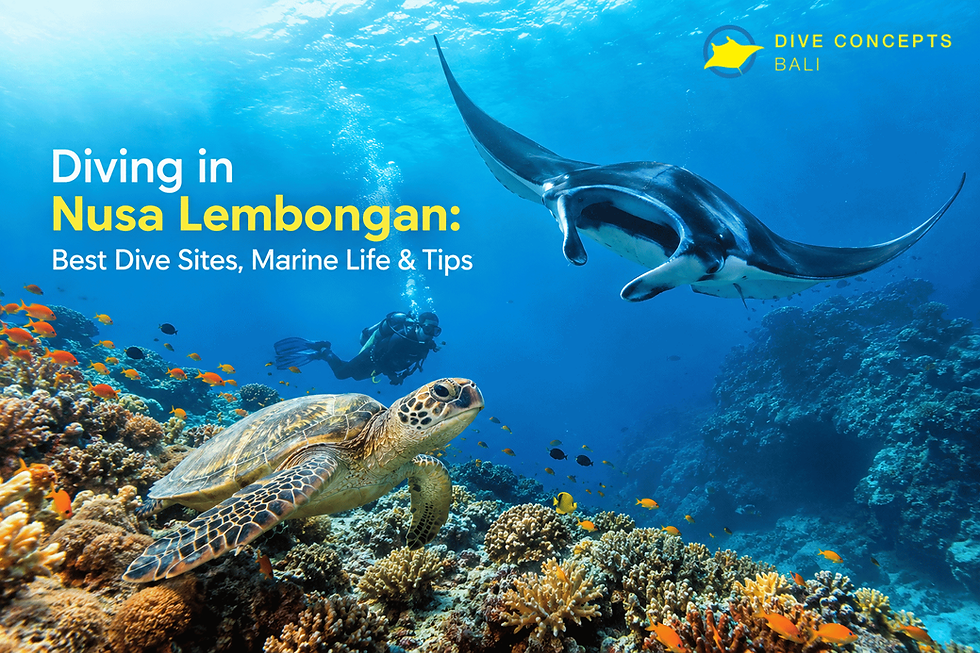
Nusa Lembongan, together with its neighboring islands Nusa Penida and Nusa Ceningan, sits across the Badung Strait roughly 30–45 minutes by fast boat from mainland Bali. This small cluster of islands is consistently ranked among Bali's best scuba diving destinations because of three things divers rarely find together: healthy coral reefs, year-round manta ray sightings, and seasonal encounters with the giant oceanic sunfish, the mola mola.
Key takeaway: Lembongan offers a rare mix of easy, current-free reef diving and world-class pelagic encounters but the two are usually not found at the same site, which is exactly why beginners need a curated list rather than a random pick from the map.
The islands sit within the Coral Triangle, the global center of marine biodiversity, so even a shallow, easy dive here delivers far more marine life than a typical beginner site elsewhere in Southeast Asia.

Is Lembongan Diving Good for Beginners?
Yes with caveats. Lembongan diving is good for beginners at select, sheltered sites, but the region as a whole is best known for strong drift currents, particularly around Nusa Penida. A 2024 diver-experience review of the area noted that most of the coastline is swept by high-speed currents, and only a handful of sites are genuinely calm enough for first dives.
This means Lembongan isn't a "beginner destination" in the way, say, the Gili Islands' shallow house reefs are. It's a destination with specific beginner-safe pockets inside a generally advanced, current-driven dive area. Choosing the right site and the right dive center to read conditions on the day is what makes or breaks a first-time diver's experience here.
The 6 Best Lembongan & Nusa Penida Dive Sites for Beginners
Mangrove Best All-Round Beginner Site
What it is: A gentle drift dive on the northeastern tip of Nusa Lembongan, named for the mangrove forest at the entry point.
Mangrove has a flat, sandy-to-reef bottom around 12–15 meters, making it forgiving for buoyancy practice. The current here is usually mild to moderate and highly predictable, and the site is rated suitable for all certification levels, including first-timers on a Discover Scuba Diving experience.
Why it's important for beginners: Because the current is gentler and the plateau is wide and shallow, new divers can focus on breathing, buoyancy, and basic navigation instead of fighting conditions. Expect turtles, angelfish, scorpionfish, boxfish, and colorful reef fish along a shallow reef edge.
Depth: 5–15m
Current: Mild, predictable drift
Visibility: 15–25m
Best for: Discover Scuba Diving, Open Water students, first certified dives

Lembongan Bay Best for Try-Dives & Night Dives
What it is: A small, sandy-bottomed bay on the island's east side, home to an artificial reef restoration project.
The sandy bottom and shallow depth make Lembongan Bay one of the only sites in the region explicitly recommended for beginners, underwater photographers, and night divers. Because there's little to no current and depths rarely exceed 12 meters, it's a common choice for a controlled first ocean dive, refresher dive, or an easy snorkeling session.
Depth: 5–12m
Current: Minimal to none
Visibility: 10–20m
Best for: Absolute first dives, refresher courses, night dives, macro photography
Toyapakeh (Shallow Section) Colorful Reef, Manageable Current
What it is: A wide, sloping reef off Nusa Penida's north coast, famous for a wall of soft corals and schooling fish.
Toyapakeh has both a shallow plateau and a deeper wall. The shallow section, typically dived first before drifting along the wall, offers a manageable current and exceptional coral coverage, making it accessible to newly certified divers when conditions are calm usually guided by a local instructor who reads the day's current strength.
Depth: 5–18m (shallow section)
Current: Light to moderate, site-dependent
Visibility: 20–30m
Best for: Newly certified Open Water divers with a guide
Pura Ped (SD Point Area) Turtle-Rich Sheltered Reef
What it is: A north-coast site near a small underwater temple, known for consistent turtle sightings and soft coral gardens.
Pura Ped tends to have calmer conditions than the more exposed south-coast sites and is regularly used for guided beginner dives when the current at other sites is too strong. Expect turtles, gorgonian fans, and reef fish in relatively shallow water.
Depth: 8–18m
Current: Light to moderate
Visibility: 15–25m
Best for: Beginners diving with a guide, easy drift practice
Bali Manta Point Beginner-Friendly Manta Encounters (Weather Permitting)
What it is: A cleaning and feeding station on the south coast of Nusa Penida where reef manta rays gather year-round.
Manta Point is shallower than most people expect (8–12 meters at the cleaning station) and the current is usually manageable, but the south coast can have surface chop and surge. Beginners can dive here successfully with a guide on calmer days it's one of the very few places in Bali where manta encounters are realistic on an early Open Water dive.
Depth: 8–12m
Current: Variable light at the cleaning station, can build with surge
Visibility: 10–20m
Best for: Newly certified divers, on calm-condition days, with a guide
Crystal Bay Only for Beginners on Calm Days, With a Guide
What it is: Bali's most famous dive site, on the southwest of Nusa Penida, known worldwide for mola mola sightings from July to October.
Crystal Bay is frequently misclassified as a "beginner site" online because it's shallow and beautiful but its currents are unpredictable and it has a channel with a documented history of divers being caught in strong outflow. It is included here not as a default recommendation, but as a site beginners should only attempt with an experienced local guide, on a day the dive center confirms conditions are calm.
Depth: 5–30m
Current: Unpredictable, can be strong
Visibility: 15–30m
Best for: Certified divers with a guide, ideally not a first ocean dive
Beginner vs. Advanced Dive Sites: Comparison Table
Dive Site | Depth | Typical Current | Visibility | Beginner Suitability |
Mangrove | 5–15m | Mild | 15–25m | ✅ Excellent |
Lembongan Bay | 5–12m | Minimal | 10–20m | ✅ Excellent (best for first dives) |
Toyapakeh (shallow) | 5–18m | Light–moderate | 20–30m | ✅ Good, with guide |
Pura Ped | 8–18m | Light–moderate | 15–25m | ✅ Good, with guide |
Bali Manta Point | 8–12m | Variable | 10–20m | ⚠️ Good on calm days |
Crystal Bay | 5–30m | Unpredictable | 15–30m | ⚠️ Guide required, not a first dive |
Blue Corner | 12–30m+ | Strong | 15–30m | ❌ Advanced only |
SD Point / open channel sites | 15–30m | Strong drift | 15–30m | ❌ Advanced only |

Best Time to Dive in Lembongan as a Beginner
Direct answer: The calmest conditions for beginner diving in Lembongan are from November to May (rainy/shoulder season), when currents are typically gentler and surface conditions are smoother, even though visibility can be slightly lower than the dry season.
The dry season (April–October) brings the best visibility and is also mola mola season (July–October), when water temperatures at depth can drop to 18–22°C due to cold-water upwellings spectacular for spotting sunfish, but colder and often rougher, which is more suited to certified, comfortable divers than absolute beginners.
Seasonal snapshot:
Surface water temperature: 26–29°C year-round
Temperature at depth (dry season, Jul–Sep): Can drop to 18–22°C, occasionally lower
Visibility: 15–30m average, up to 40m in the dry season
Mola mola season: July to October (peak: August–October)
Manta ray sightings: Year-round at Manta Point, with April–May often producing "mating train" behavior
Practical tip: Beginners diving in the dry season should rent a 5mm wetsuit (with hood if sensitive to cold) rather than the standard 3mm, since thermoclines can appear even at sites away from Crystal Bay.
What Certification Do You Need?
Direct answer: You don't need any prior certification to dive Lembongan's beginner sites; a Discover Scuba Diving in Bali (DSD) experience lets first-timers dive with an instructor at a 1:1 or 1:2 ratio. If you want to dive more independently, an Open Water Diver certification (PADI or SSI, both offered locally) is the standard entry-level qualification and typically takes 3 days.
Certification | Who It's For | Typical Duration | Access |
Discover Scuba Diving (DSD) | First-time divers, no certification | 1 day | Shallow, sheltered sites (Mangrove, Lembongan Bay) with instructor |
Open Water Diver | New divers wanting a real certification | 3 days | Most beginner and moderate sites, with a guide |
Advanced Open Water | Certified divers wanting deeper/current dives | 2 days | Crystal Bay, Blue Corner, deeper walls |
Both PADI and SSI agencies are widely taught in Lembongan; the certifications are internationally recognized and functionally equivalent for recreational diving.
Common Mistakes Beginners Make in Lembongan Currents
Choosing a site based on Instagram fame, not conditions. Crystal Bay and Blue Corner are the most-photographed sites but the least beginner-appropriate on a bad-current day.
Skipping the pre-dive briefing. Local dive guides check current direction and strength each morning. This briefing is not optional small talk, it determines the entire dive plan.
Diving with an unfamiliar or non-local operator during mola mola season. Conditions change fast in July–October; an operator without daily local knowledge may run a dive at the wrong site or time.
Underestimating cold water. Many first-time divers pack only a 3mm wetsuit and get caught by a dry-season thermocline.
Trying to "keep up" in a drift dive instead of relaxing into it. Fighting a current burns air fast and increases panic risk. A good guide will teach beginners to drift, not swim against the flow.
Cost Breakdown: Courses & Fun Dives in Lembongan
Approximate 2026 pricing with Dive Concepts (Nusa Lembongan center), in Indonesian Rupiah with approximate EUR conversion:
Product | Price (IDR) | Approx. EUR | Duration |
Discover Scuba Diving | Rp 1,575,000 | ~€80 | 2 Days / 1 Night |
Open Water Course | Rp 5,200,000 | ~€265 | 3 Days |
Advanced Adventurer Course | Rp 4,850,000 | ~€247 | 2 Days |
1–4 Fun Dives (certified divers) | Varies by package | — | 1–2 Days |
Pack of 5 Fun Dives | Rp 2,750,000 | ~€140 | 2 Days |
Pack of 7 Fun Dives | Rp 3,360,000 | ~€171 | Min. 3 Days |
Snorkeling Trip (with manta rays) | Rp 1,785,000 | ~€91 | 2 Days / 1 Night |
Prices are indicative and subject to change; confirm current rates directly with the dive center.
A Beginner's Decision Framework
Use this quick framework to choose your first Lembongan dive site:
Have you never dived before? → Start with Discover Scuba Diving at Mangrove or Lembongan Bay.
Are you newly Open Water certified (under 10 logged dives)? → Choose Toyapakeh (shallow) or Pura Ped, guided.
Do you specifically want to see manta rays? → Bali Manta Point, on a calm-conditions day, with a guide.
Do you want mola mola but are still building confidence? → Dive Crystal Bay only with an experienced local guide, and only if the operator confirms manageable current that day otherwise wait until you're more experienced.
Are you comfortable in moderate current and want more challenge? → Progress toward Blue Corner after gaining local dive experience, ideally with Advanced Open Water certification.
Expert Tips from Dive Concepts Instructors
Dive early. Morning dives generally have calmer seas and less boat traffic, especially important at exposed sites like Manta Point and Crystal Bay.
Trust the daily site call. A responsible operator will change the planned site based on that morning's current and swell; this is a sign of a good dive center, not a downgrade.
Log your first dives at sheltered sites before adding current. Confidence built at Mangrove or Lembongan Bay transfers directly to handling drift dives later.
Free Nitrox, where offered, extends your no-decompression limits on multi-dive days useful once you're comfortable with basic buoyancy control.
Book mola mola season trips early. July–October is peak season and also peak demand boats and rooms fill up in advance.
Key Takeaways
Lembongan diving is beginner-friendly at specific sites Mangrove and Lembongan Bay are the safest choices for first-time and newly certified divers.
The wider Nusa Penida/Lembongan region is known for strong, unpredictable drift currents, so site selection matters more here than in most beginner dive destinations.
Crystal Bay and Blue Corner, while famous, are best approached with caution and a guide not as a default first dive.
Mola mola season (July–October) brings colder water and stronger conditions; manta rays are visible year-round at Manta Point.
Both PADI and SSI certifications are available locally; a Discover Scuba Diving experience requires no prior certification.
A responsible, local dive center that adjusts the site to daily conditions is the single biggest factor in a safe, enjoyable beginner experience.
FAQ
Is Nusa Lembongan good for beginner divers?
Yes, at specific sheltered sites like Mangrove and Lembongan Bay. The wider region has strong currents, so beginners should dive with a local guide who selects sites based on daily conditions.
What is the easiest dive site in Lembongan?
Lembongan Bay is generally considered the easiest, thanks to its sandy bottom, shallow depth (5–12m), and minimal current it's commonly used for first ocean dives and night dives.
Do I need a certification to scuba dive in Lembongan?
No. A Discover Scuba Diving (DSD) experience lets uncertified beginners dive with an instructor. For more independence, an Open Water Diver course (3 days) is the standard first certification.
Can beginners see mola mola in Lembongan?
It's possible but not guaranteed, since mola mola sites like Crystal Bay have unpredictable currents. Beginners with some dive experience can go on calm days with an experienced guide; it's not recommended as a first-ever dive.
When is the best time to dive in Lembongan for beginners?
November to May generally offers calmer sea conditions, though visibility is best in the dry season (April–October). For calmer water and easier conditions, shoulder months like April, May, and November are a good balance.
Is Crystal Bay safe for beginners?
Crystal Bay can be dived by beginners only under specific conditions: with an experienced local guide, on a day with confirmed manageable current. It has a history of strong, unpredictable currents and is not a recommended first ocean dive.
What's the water temperature in Lembongan?
Surface temperatures run 26–29°C year-round. During the dry season (especially July–September), temperatures at depth can drop to 18–22°C due to upwellings tied to the mola mola season.
PADI or SSI in Lembongan does it matter?
Both are internationally recognized and widely taught locally. The choice mostly comes down to which agency your chosen dive center uses; the recreational skills and safety standards are comparable.
Plan Your Dive with Dive Concepts
Dive Concepts has operated a dedicated dive center in Nusa Lembongan since 2009, offering PADI and SSI courses, guided fun dives across all the sites covered in this guide, and free Nitrox across Bali. Whether you're booking a Discover Scuba Diving experience at Mangrove, working toward your Open Water certification, or hoping to time a Manta Point or mola mola dive with an experienced local guide, the team can match your certification level and comfort with the right site and season.
Comments